 ModCodePlus Team
Many companies enter a new market by translating their website and waiting for enquiries. Then nothing happens. The German version doesn't show up for German searches, or Google keeps showing the English page to people in Poland.
The translation itself is rarely the problem. Search engines need clear signals about which page is meant for whom. Here is what we set up on every multilingual site we build, including this one, which runs in English, Turkish, German and Polish.
Give every language its own URL
Google has to be able to find and index each language version separately. So every language needs its own address, not a page that switches language through a cookie or a browser setting.
There are three common ways to structure this:
- Country domains (example.de, example.pl) send the strongest local signal, but each domain has to build its reputation on its own and costs more to run.
- Subdomains (de.example.com) are easy to host separately, but search engines often treat them almost like separate sites.
- Subfolders (example.com/de/) let all languages share the authority of one domain. For most small and mid-sized companies this is the most practical choice.
This website uses subfolders: English at the root, and /tr/, /de/ and /pl/ for the other languages.
Use the page's language in the address too
A German page at /de/services/web-design is a missed opportunity. Wherever you can, put the address in the same language as the page: /de/leistungen/webdesign. On this site, every blog article has its own address in each language. It's a small detail, but it reads more naturally in search results and in shared links.
Use hreflang, and use it correctly
Hreflang tags tell Google that several pages are versions of the same content in different languages. Done right, someone in Poland sees your Polish page in the results instead of the English one.
Three rules prevent most mistakes:
- Every version lists all the others, and itself. If the German page points to the Polish one, the Polish page has to point back. One-way references are ignored.
- Add an x-default. It tells Google which page to show when none of the languages match, usually your main or English version.
- Only reference pages that really exist. If an article isn't available in Polish yet, don't point to a Polish address that redirects somewhere else.
Research keywords per market, not per translation
People don't search in translated sentences. A German business owner is more likely to type "Website erstellen lassen" than a literal translation of your English keyword, and in Poland people use their own phrasing again. Research keywords separately for each market, then write or adapt the text around what people actually search for.
Machine translation needs a human
Automatic translation has become surprisingly good, but publishing it unchecked is still a risk. Small errors in tone, terminology or grammar make a company look less trustworthy, and search engines are built to reward pages written for people. Use translation tools to speed things up, then have a native speaker review every page before it goes live.
Don't redirect visitors automatically
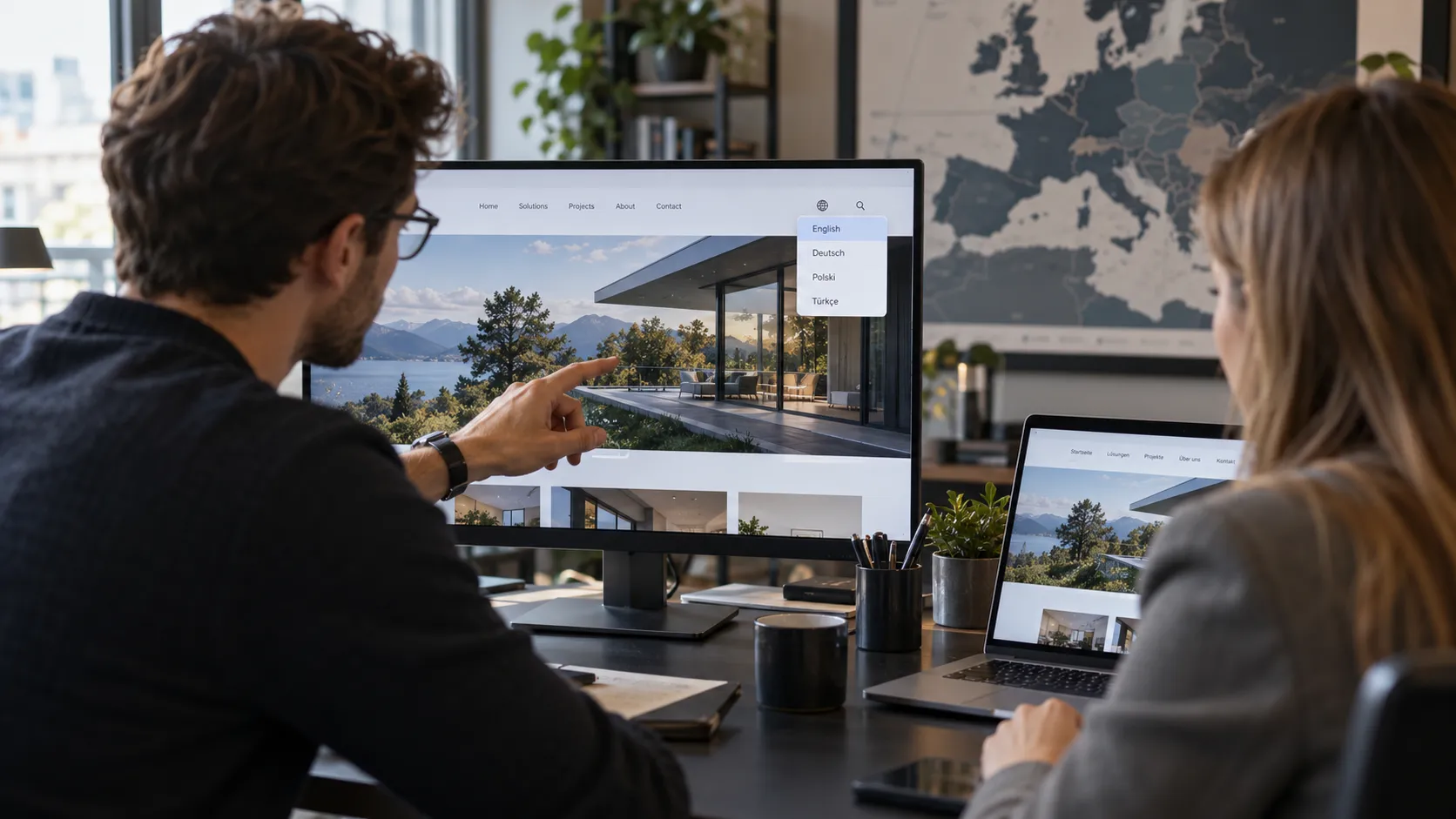
It's tempting to send visitors to "their" language based on their IP address or browser. Google advises against automatic redirects like this: its crawler may never see your other versions, and real visitors get frustrated when they can't open the page they asked for. A visible language switcher that leads to the same page in another language works better for both.
Localise more than the text
Currency, date formats, phone numbers and units all tell visitors whether a site was really made for their country. So do the legal pages: German visitors expect an Impressum, and Polish limited companies list their registry court and share capital. Payment methods differ too, as we explain in our comparison of e-commerce platforms. And every language version needs the same privacy care, which our GDPR checklist for business websites walks through.
How many languages should you start with?
Probably fewer than you think. Two well-researched, well-maintained languages beat five neglected ones. Every language adds ongoing work: new pages, updates, articles, answers to enquiries. That's also one reason multilingual sites cost more, as we explain in our article on what drives the price of a business website.
Our own product, eSIM Travel, runs in ten languages, so we know how much discipline that takes. If you're planning to reach customers in Germany, Poland or Turkey, tell us about your plans. We'll help you decide which markets to start with and set them up properly from day one.